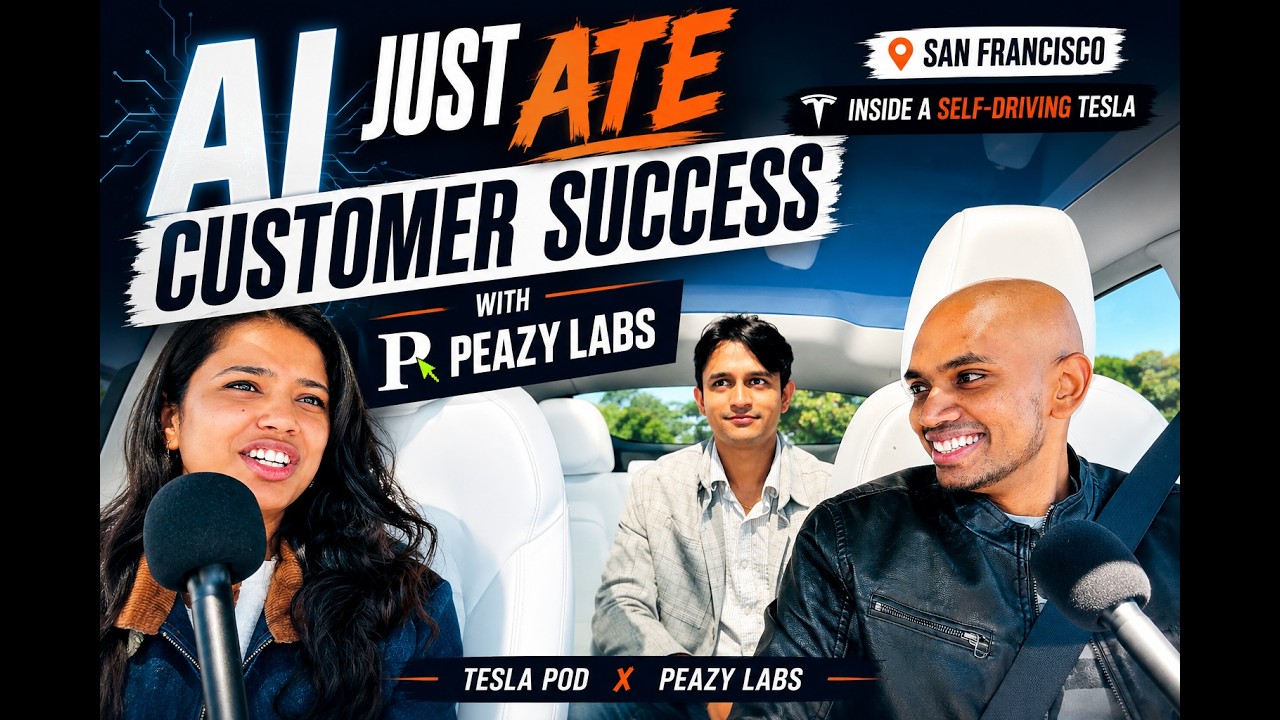
About this episode
Two teenagers from Agra started building startups at 14. At 15 they were rejected by Y Combinator. At 18 they raised a $500K check from YC.
Shreyans Jain and Naman Bansal are the cofounders of Manicule, which builds AI-native technical documentation for developer tools. Riding through San Francisco in a self-driving Tesla, they talk through the years of failed experiments, late-night coding sessions and curiosity that eventually compounded into something real.
What they get into
- Their journey from Agra to San Francisco
- Applying to YC as teenagers
- Building and failing repeatedly before finding traction
- Why AI-native documentation became a real business
- How Manicule scaled through AI automation
- The future of dev tools, AI agents and startups
- India vs San Francisco for founders
- Hot takes on AI startups and services businesses
For young founders, YC hopefuls, and anyone building developer tools.
The passengers

Shreyans Jain
Cofounder · Manicule (YC P26)

Naman Bansal
Cofounder · Manicule (YC P26)
About Manicule
AI-native technical documentation for developer tools — “DevRel for agents.”
The insights
Skip the résumé decade: two 18-year-olds on conviction, YC, and docs written for AI agents. The write-up pulls out the big idea, the numbers, the counterargument and what it means for the autonomous future.
Transcript
Auto-generated from the episode audio and lightly cleaned up, so expect the odd misheard word. Each timestamp opens that moment on YouTube.
Read the full transcript 15,624 words
0:00 So we have Shreyans and Naman from Manicule here and we are we are rolling through SF in a self-driving Tesla and we have 20 two 18 year olds right from Agra with a 500k IC check right so how does this moment feel man I mean at this point we're kind of used to the moment it's been like 2 months of the moment right the moment is at the yeah at the initial moment it was when we got in it was a lot of confusion, right? Not even adrenaline. It was weird. It was we couldn't at least I couldn't understand it for a few hours. I was like walking around and pacing around like what the happened? Yeah. I was I was I was back in Agra at the time at home. I had just gotten back from SF like 2 weeks less than two weeks before then.
0:51 After having been in SF for 6 months. and so I had just gotten back and I was on this it was our second interview with YC. The one the first one I did right after I landed literally in India like 2 hours after that right. so it was our second interview. We I don't know I don't think we were 100% expecting them to take us. They were kind of skeptical about a few things. but I found out what were their initial concerns before they got your way? the concerns were mostly around monetizability of what we were building at the time like how much and how fast could this make money, right? and there was no good answer to that at the time cuz you know we had no paying customers on that. so they asked for alternate ideas. We proposed two main alternate ideas. Nam was already building another company. It was called Manicule at the time, right? so he was like manually serving customers with documentation and it was like the highest quality documentation. so we that was one of the ideas we proposed it was making a very good amount of money and YC was like this sounds cool but when they accepted us right in the meeting they did say key you know even though you proposed this as your last thing
2:10 Now that you're in you can build whatever you want you can go back to the original idea can go to some other idea we don't tell you what to build we just help you build whatever you want to right for context we had applied with something else then we had our first interview they said they didn't they raised the objections with that idea but they were like that we think you guys are really smart so we want to work with you want to work on something else and that is when we pitched the two other ideas and then they took us in right that's crazy man congrats right so because I think like you know we had our initial chat at founders inc right so and then the product was called what was it called in the beginning it was called modify with AI yes I remember that. Yeah. you know, at one point I thought it was something similar to what you were doing, but then we had a chat and we realized it wasn't, right? so it was like basically modifying websites at runtime based on user preferences. Dynamic UIs.
3:12 Yeah, dynamic UI. and later on you know naman when he came in town for like 2 weeks there was a YC hackathon being organized by better o so we just participated in that we decided to build this thing called better command K for it was like a command pallet demoing at Founders Inc. if I'm not mistaken. Yeah. Yeah. Yeah. Yeah. We everyone kind of really liked the idea of that and you know we won second place at the YC hackathon as well. so it was it was really going good. So we kind of it was it was still dynamic UI was included as a part of it like the command pallet could also you know modify UI and stuff like that. so yeah that's what we decided to demo at artifact festival. Right. Right. That's awesome. I mean, I was reading somewhere that you all have Okay, now you're 18 years old, right? So, you've been in the game since 14 or 15, right? And you first applied when you were 15 if I'm not mistaken, right? So, I mean, what's that story about? That's crazy, right? So, so like basically I had Nam was I
4:31 Had like switched schools into like one the one Naman was at. in the in 9th grade. So I was 14 then. So in 10th grade I kind of went into this you know special extra study class that you could opt into with like less than usual amount of kids in that and Nan was in that too, right? so we kind of met and instantly hit it off. We had the same interests with tech and programming and all that. and I think that was that was around April I think of 2022. and in May, so my birthday was in May and I think around my birthday, maybe before or after it. So we used to do a lot of like late night FaceTime calls discussing random so we were he just pitched me. He was he was doing like freelance writing at the time. You want to tell more about that? Yeah, my story basically is I've been working online since I was 13. So during the lockdown I was pretty bored. I started a blog and then some company really liked it. It was like technical articles and stuff. So they asked me can we hire you and I was like sure. So I started doing that freelancing. I was doing that for a couple years and you know the usual route when you go from like a freelance services business to try to productize it. That was what was going on in my head and I was trying to
5:52 Do that. That is around the same time I met Shreyans and I like decided I want to do something in the product based startup world. So then I pitched him the idea of building a freelance management platform and he was like sure why not. And we did that. We made an MVP and learned a lot of programming applied to YC with that a couple of times. This 2020 this was 2022. yeah we I mean you kind of skipped over all the parts where we fumbled over literally everything where it took us months to do what should take days. now it takes days at that time in hand programming. Yeah. I mean even in even in hand programming we were we were much slower than people who know even the slightest of Yeah. Yeah. Yeah. Yeah. Yeah. we didn't know anything about anything like to kind of give a signal of how stupid we were. we were we were we were deciding on a on a stack to build a landing page and we would have spent at least like 2 weeks 3 weeks deciding on that multiple hours to build the landing page. Yeah. Just deciding between React and no man no that came after we hit at least some knowledge. Initially we wanted to build the landing page in Rust.
7:14 You know, we wanted to build I think that was all you. I don't remember this. You don't remember but I was we wanted to build it in Rust. A landing page, a web landing page in Rust, and Rust didn't have web, so whatever. Then we went into that. Why Rust though? It was It was the It was the cool thing. It was It was like this is the new cool thing. Everyone is rewrite it in Rust. So, we were like, let's write it in Rust in the first place, right? so, that was stupid. then we decided that Rust isn't going to work out. Let's move to JavaScript actually that some everyone else uses. We moved into that. We started comparing that and we were again stupid enough. So Svelte if you know about it had their own like full stack next.js like framework coming out called SvelteKit. But at the time it was an alpha.
8:04 They had barely built it out. It barely worked. But we thought it was the cool new thing. And in our comparisons of better, we realized that was better in ways. we ended up going with that facing many issues that we found out later were not our problems as beginners, but the framework itself was broken at the time. So we just we spent literally months making a landing page, right? A basic landing page like had two pages maybe. but yeah, at some point we realized we started doing stuff. we still couldn't make money with the product. So we basically started doing the work so we called it duelance right it came for like due as in like so initially it was like a management for your freelance work so it had like time tracking and stuff like that so it was due and freelance duance we built that we spent a few months we realized we weren't making any money from the product so we kind of naman mainly went into this manual mode of so before that we pivoted we realized through some calculations I still don't remember what exact calculations that nobody wanted this
9:21 And we instead started building a freelance marketplace like Fiverr but like automatically matched by AI like where people you know who want work and who need to give work are matched by AI. we had no idea how to use AI. AI was barely a thing at the time. I don't think GPT3 had come out at the time. so we flopped that as well. but we kept we kept building it for a while and in the meantime to get some money for something we didn't need it but yeah we did it manually. So the kind of matching services it basically became like a traditional freelance agency. That is where we made all our money right.
10:04 And we partnered with a British company other ship. We did a joint venture with them to kind of white label our product. they were like a co-working space finder thing in the UK. we did that made a few thousand dollars. We all kind of we both kind of went away from it in a while. We had other stuff to do. Nan had moved to a new school as well boarding. So we didn't have time so it kind of fizzled out within like 9 months or so. Yeah. Right. That's awesome. So would you think I mean like this kind of sets the foundation right to what you are doing right now as well right. So can you tell right with regards I mean what we were discussing from founders inc right this modify AI right to how it has actually transitioned to like you know what you are doing right now with manicule right.
10:58 How you know that transition and what sort of foundation do you think that modify and all these past to what you're doing right now? Yeah, I mean between dual lance and now manicule I have done like a bunch of stuff like I at this point I probably have like at least a hundred repos on my GitHub account and you know a few more on different org accounts I created along the way. So it was a lot of experimentation. It was mostly failing, not succeeding at almost anything. but all of the failure generally led to learnings that could be applied to the next failure and at some point some sort of success. some of my like personally now talking like not a lot of stuff I did not with N in between. So I was so I was at I was in buildspace season 4. I think that was pretty cool. That was the first time I kind of started building around AI. That was an accelerator in India. no buildspace is a very popular it was like a community of builders. it was run by this guy called Farza
12:15 Farza Majid. so he started it around 2020. I think it's actually a YC company, right? it was also Founders Inc. I think you should probably know about it. He's very close to the Founders Inc. founding team. build space's office was based inside Founders Inc.'s office in Fort Mason. Right. Right. so he was doing that. He was like encouraging people around the world to build stuff and he did that with me and many others as well. so I participated in season 4 of this thing they call nights and weekends, which was basically where you have a job or you study or whatever and nights and weekends you do this. You build something, you show it to the world. So that's where I started building AI stuff. I built like what did I build for? I built an email search tool that used AI to basically you could search in natural language through your email.
13:10 It was really bad. was like horrendously bad. It didn't work most of the time. It was over complicated in ways it didn't need to be. and I didn't even know about the concept of vector search. So I was it was it was it wasn't going to work. but it still got me invited to their in-person event. That was I think the only year they did two inerson events. One was in this 23 24 this is 23 right? one was in SF as always in their Fortm Mason office and the other one was in Dubai. So, I was much closer to Dubai. The ticket was much cheaper everything. I had they were not sponsoring my ticket. So, I had to do that on my own.
13:57 So, I just kind of asked my mom, you know, what do you think about this? should I go? I'll just leave the decision to you cuz it is still a good amount of money at the time for me. and she was like, "Yeah, you should go." So I just went to Dubai. I was I was 16 at the time. So 2023. they questioned me at the border. Why are you alone? Why are you 16? You know, what are you doing? This is who is the adult with you? And they almost didn't let me in. They actually almost didn't let me in. They were almost going to like send me back, right? but they did let me in thankfully. So that was a that was three crazy days in Dubai. Amazing experience. One of the best in my life. still made some good friends there. crazy thing that FARZA organized. I still can't believe it. At the time I kind of said that Buildspace is too good to be true. And that turned out to be a reality cuz they had to close down last year. cuz it was actually too good to be true. They weren't making money. Everything was like free. Everything was sponsored. You know, you they were just promoting people promoting like these kids building stuff. that was big part of it. Then I was in this or called hack club. so hack club basically is like again like an organization specifically of teenagers around the world. It's a nonprofit.
15:15 It's based in the US. They promote teenagers building and doing stuff, right? they sponsored a I built a PCB with them to be short like a printed circuit board. The first time I designed it sounded cool. I did that. They invited me to a track in here in California, Pacific Rest. So they sponsored everything, my flight, my stay, all the stuff I needed throughout it, the printing of the circuit boards, all of it. So they just in that, you know, month or two months of time, they probably spent a few thousand on this nobody from Agra. And that's what made you really believe in San Francisco? not in San Fr that that trip didn't even really come to San Francisco only the airport was the only San Francisco I did at the time right it was more like again an exposure experience of the world I had come to the US before many times that was my like second time coming here alone I think but it was more of like it there was a community effect we were 30 teenagers from around the world hiking in this random forest of California. so it was it was just them promoting something, you know, it was like things are possible. You can just do things. You can just do things was, you know,
16:35 The like buildace and hack club kind of thing. Later on like last year I even went to China with them. They sponsored that as well. So really great. I've been kind of giving back to them like sponsoring them every month now as a nonprofit cuz they were like really pivotal to my journey. Right. That's awesome man. I mean what a what a journey. Right. So u I mean now I think I have a great understanding regarding your origin story. Right. So coming to what you are building now with manicule right. So what is this right? What is manicule exactly? Right. So I know that it's technical documentation. Right. also like you know out of all the things that you could do right why technical documentation I think there's I mean it's again it's a it's a series of events that led to it wasn't like a point in time where we thought what should we do and we just did this you know Nan as he said has been writing since 13 and over time he learned through talking to a lot of people he's really good at selling which is his main thing what people need and want and documentation came up all the time when he was writing like blogs and stuff. So you know sometime last
17:54 Year he just decided you know let's just try this let's try to write documentation. I was at super memory at the time as their founding engineer. and I so he was talking to me and I was like I maybe I can refer you to super memory. and I did and you know the founder loved him and soon he was working for super memory their first client for documentation. The documentation was amazing. it went viral on Twitter. some of the best documentation people have ever seen. And then that led to the so I did the super memory work and then that led to a ton of inbound grappile reducto all of these companies they came in and that is when I realized that is actually a problem that these companies are facing specifically pre- series A I would say pre- series A to series B companies they have product market fit the they're growing fast but they know the value of docs first of all they just don't know what good documentation looks like how to do it second the founder does not have the time to do it and so it always ends up on the backlog, right? They have the money to fix it. and so based on all of this, it turned out to be an actually viable business idea. And so I so I went from basically
19:14 Nothing to in a span of four to five months the business was doing consistently 10,000 $12,000 a month in revenue from just documentation. and then what I realized was that this it's a good business. The thing is documentation is so cross functional. You need to talk to engineering to support. You have to get a bunch of data. AI wasn't exactly the best at it. That's kind of the moat as well to have us in the loop. I just I realized that to scale the business I would have to start automating a lot of the stuff to go from an agency to an AI native agency. Claude really started taking up at putting like it took off at that time. I was technical but I wasn't technical enough to handle everything by myself. I started hiring teammates and everything but it was it was okay. We weren't doing anything great in terms of technical stuff and then all of this YC stuff happened. Shreyans came on and that was basically like the sort of catalyst we needed to go from just the agency thing to being more automated, being able to achieve better scale. I'm good at the business part of things. I can sell. I can understand my users. But the functionality to
20:35 Deliver at scale, I think that is where Shreyans came in really helpful. Right. That's awesome. So, this AI native agency, I think that's a quite a new term that's come up as well. Right. So, can you walk us through right what what exactly is an AI native agency and then how is it fundamentally different? I can walk you through our process which should give you an idea of what it means. So documentation how we write it is first of all you get on an onboarding call with the founder or devrell head whoever you understand after that you get context about what they're trying to do. You understand their code base explore that and then you create a structure for how the documentation should be that guides the overall strategy. Then you write all the docs. Then you verify that everything is working and then you push it out. Now in this process the strategy part I think has to be human. We can automate it. We don't want to. I think you need that human input to really decide messaging nuance who your user is. Understand that is the whole value of having humans in the game. But the deterministic things like for example if I've written a documentation for an API company verifying it. I don't want to spend 40 minutes trying to stitch together a few API calls and testing what I've written works or not. Right?
21:52 That is where AI comes in. We have built agents that can go over our entire documentation, scrape every snippet, run it in a bunch of sandboxes and tell us that okay, this is all good. This works exactly as it is intended to. Same with writing. I developed a lot of knowhow into how I can steer claude into the right direction to make good dogs. And now we've built internal pipelines that basically put claude in a long running loop, make it fix itself, make it write decent first draft that we can then review, push out quickly. So that has helped us condense. So it used to take us one month to deliver an end toend project about like a 100 pages of documentation. Now we do it in two weeks the whole thing.
22:35 So that is what AI native means. It means you have the expertise in the industry. You use it in the best possible way to make things faster without losing quality. I think a lot of people compromise on quality. That is not what we want to do and that is not what we're doing. So yeah, really happy about that. Right. Right. Right. So that's very comprehensive Nan. Right. So now u I mean we all know Mintlify, right? So I mean compared to something like Mintlify which is a product, right? And then you're driving this approach in an AI native agency standpoint, right? like do you have plans towards getting towards like building a product or are you using something like Mintlify to drive this forward? how does like you know sort of product versus service side of things work out? Yeah, that's a good question. Most of our prospects ask us as well how we different from Mintlify if we heading in that direction. Us and Mintlify aren't really competing.
23:33 We Mintlify is like Microsoft Word. We are like the typewriters on top of it. They provide the infrastructure. We have all the knowhow of writing the good dogs and we do it. A lot of our clients are on top of Mintlify and we actually re-engineer their dogs on Mintlify itself. We are also now working more into writing documentation for agents and optimizing it for agents. So we've been exploring some other directions there. So we can engineer our own approaches to doing that. maybe leave Mintlify and do some stuff on our own. We are seeing good numbers and benchmarks but we don't have any concrete plans I would say to compete in the product space right now. Our whole game is delivering the right outcomes. Right now one of the outcomes we are focusing on is delivering better agent optimized dogs and showing the value to our customers and that is really what we've been working on. All right. So let's move on move on to some rapid fire questions. Right. so what's the hottest take that you have right now in the that you think that's there in the dev tool space right now?
24:43 I think I don't know how much like what kind of impact AI will have long-term on dev tools. some people seem to think that the volume of dev tools will increase. I generally think the volume will decrease by a lot. and there will be like a very few base providers left of you know developer technology who are like there will be more AWS and you know less people doing one thing. cuz at some point when an agent is doing everything developer experience becomes a much smaller fact. and when agents become good enough, I think even agent experience will become a smaller thing. an agent will be able to kind of understand and use whatever they're given even if it isn't as good architected towards agent as it needs to be today where someone like Versel is doing great stuff with their agent architectures in their CLI tools and all that but someone like Amazon is not. but I think that gap is going to become smaller and the like raw kind of leverage you have in the world is
26:04 Going to become a bigger part of who wins, right? That's awesome. So, what's one AI startup idea that you think that's overrated and then one that's underrated? Underrated, I would say, is still just services. I think services don't seem venture backable to a lot of people. So people think it's unsexy and things like that. I think it's the biggest opportunity when software becomes abundant. Nobody needs more software. They just need somebody who does it for them and delivers the results. Overrated. I think things like AI CMO and basically companies that position themselves as replacing entire human functions are overrated. Anybody who is decently good at their industry knows for some industries at least knows that agents just aren't there. You need to steer them in the right direction.
27:03 And at the end of the day, if you try automating everything, the time you spend then manually d like putting it into the right direction, you could just you would be better off just doing a 50/50 split or something like that if that makes sense. Right. Right. Absolutely. So, if you weren't really building manicure right now, what would you be building? I don't know exactly. Maybe I was I was like I was experimenting with, you know, like you heard with the about the recent like GitHub issues like outages and stuff over the last month and so they have been having a really bad time. I think they're down to some 80% something. uptime which is horrendously bad for a company their size. I was experimenting with you know making a like GitHub as a service kind of thing. git as a service you know where you can have more than like git itself is just the basic kind of tracking of you know files and code over time. It doesn't provide necessarily this kind of concept around issues and pull requests and all that.
28:14 That is where something like GitHub comes in. so the question now that some people posed was is there an AWS for git coming around at some point where these companies are going to build on top of it like there's going to be a versell on top of this AWS for git and you can have multiple choices cuz right now it's basically GitHub is a defacto it has like 85% market share right so yeah that's a cool idea that we could try to do we don't have much expertise in the area I It's a very hard problem to solve with the agent volume that is now like the number of commits that were made in an hour are now probably made in a minute. So it's a hard problem to solve but I think it's doable and probably more people are trying to solve it. Right. India versus SF for building.
29:04 What's your honest answer? I mean I could talk on this for hours. I probably could but let's squeeze that into 2 minutes. Yeah. Yeah. I mean there there is nothing comparable to SF for doing what you can in SF. You don't just you just can't meet the people. You can't have the conversations. so SF for sure in at the point of India versus maybe other places that are not SF. Even if you can find a slightly better place in India like Bangalore is the only big one really in India right now. India will oppose you like the ecosystem will like actively oppose you in certain building things not just not help you but oppose you which is what a lot of people feel what a lot of Indian founders feel a lot of them that's why they oppose you in the sense of in the sense that there will always be a high level of skepticism there isn't even close to the amount of risk-taking appetite Right. And once you get at a certain level, even not at a certain level, like even maybe like YC kind of level, you have to be
30:21 Interacting with certain government functions and those will be a pain. you know, you will be extorted out of at some point in your building journey. so I generally suggest people don't build in India. try to find a way to come here or like at least just start something in India and as soon as if that's your only option and as soon as it's possible try to move to SF or you know something better right that's awesome so now that that's I mean it's quite an inspiring journey that you both of you all have had right so now one of the areas I mean you all mainly spoke about how we are writing docs for the dev tool companies, right? So now one of the areas that we are really deep into is right so how are we building these different types of characters of personas of products right and using these personas to actually test and validate products right mainly speaking like you know because why all these technical documentation why all these like you know heavy loads of testing has come in right because now people are really able to build features build products at like you know super fast pace right So but do these features or
31:40 Products really make sense or not? Right? So that's actually the real question. Right? So then I mean most of the time you are only able to get to know after you actually push these products out to the market. Right? So now the perspective that we are taking is okay now rather than you waiting right all the time right until you like you know put the products out to the market and then get people to try out and test things out right. So the perspective we are taking is I mean hey we understand who the characters like the personas of kinds of people that's really using your product right letting them to actually test the product and then get it validated right so now you're writing a lot of technical documentation right so I'm curious to understand like you know with the customers that you're working with right so is this kind of a pain that you might have come across like understanding if a product has demand. One is demand, right? Yeah. Does this like you know I mean okay we just rolled out a new feature right? Yeah. Does this feature really make sense right? because I mean you have some sort of I mean there's some signal that you're getting right because of that only you that feature right but you would actually know if people would I mean what we've realized is about 80% of the features that you
32:59 Are rolling out are not really been used by people right and so that's why I'm curious to understand like you know is this kind of a pain point that you may have come across with your customers yeah I mean this was like Part of the reason I was building like dynamic UI in the beginning like one of the use cases was how fast can you test something in your users's hands to understand if people need it. and the way it did that was like basically giving users the ability to add features themselves.
33:41 So I think this will always be a need cuz feature requests and what metrics tell you about what to build are often most of them are noise. finding the right things to build first, you need the right metrics to track. being able to test if something works or not as quick as possible is, I think, really important. now that you can build things faster, the question in many things is no longer should we build it is like just let's just build it and find out. and you can't necessarily roll out every single idea that comes across and you cla to your users cuz that's not a good experience. so I think there is space for something like this in terms of our customers. G, do you have any thoughts on that?
34:39 Not really. Go on. Yeah, in terms of our customers, I think we so like we recently started doing this thing where we prevent drift in your docs by writing new docs as soon as you know a change happens in your codebase. our customers don't express this exact problem to us in any way that you know we aren't able to validate these features. Our job more is to best portray the features to their customers and then they kind of track the metrics themselves on how the customers are using those features. We don't do that tracking as of now.
35:26 Right. Right. Right. So thanks for the feedback Shreyans. Right. U I'd love to give a two minutes demo of market tricks right and then hear your candid feedback probably the first demo being done on FSD right so I'm going to do that I mean like you know you don't need to filter any feedback right so what I'd like to hear is actually the very honest right you know top of your head feedback right so what we are solving is basically that particular problem okay I mean your one from one side is that like you know when you're building out all these features you want to know if these features actually work in the perspective of your real users right and at the same time do they really make sense right so what we do is I know we build personas and let the users the sort of synthetic users right to actually test and validate your product right so that's what we do right so what would love to take you through and then hear your thoughts guys right so u basically what happens is like you know you add the credentials to your application right so it could be the staging environment or the production environment that you may be having. Let me change the direction real quick. all right, cool. So then you add the credentials in, right? And then afterwards of course you can maintain multiple
36:53 Applications that you may be having, right? So the staging environments like you know production environments and all these things right so the agent would be having an initial starting knowledge of these the documentation that you are building right so you could bring all of that here right and that could be the documentation that you may be having and then also the walkthrough videos right so you add that in and then also we'd like to have like a starting step of understanding of what your real users are doing before we start to build all these personas right so that's where like you know we integrate post talk hot jaw or else you can use like you know our widget to track the existing user behavior. M then through all these what we do is we build this personas right so persona is basically a category or type of user that's actually using your product right so we help you to actually uncover u types of personas that you might not even have thought that there might be within your product right so u I mean here we actually go now if you look at like you know this one roi driven marketing manager Mia right so if you go into that right so Okay, what is the performance radar, right? Like what has this MIA simulatedly done within your product, right? And what's the behavioral DNA of this particular person, right? synthetic person,
38:11 Right? So then persona profile, right? What are the goals? What are the key features? So likewise, I know we really get into the nitty-g gritties of that, right? Then it is those personas are the ones that actually running these simulations, right? So be it testing automation, be it feature validations, right? These personas actually get into your product, right? And then start to use it, right? And then provide you with the results, right? So let me show you like you know how a single simulation would work, right? So this is where you select who the persona is, you add the instructions, right? And then basically it spins up a virtual browser, right? And then within that virtual browser, basically that persona starts to explore the product, right? While we do that, we make sure that the whole progress is properly tracked here and then we build a comprehensive mind map of the product as this agent like you know goes through as well, right? So why I mean this mind map consists of not only the screenshots, right? But in each of the steps also the action states of the product as well right so it's like a comprehensive vector graph or like a knowledge graph that we build around the product. Right? So I mean our idea here is that you know basically as your product continues to keep on
39:28 Evolving we make sure that we have the latest understanding around the product right then the keyway automations can be done. Now these where you get one of these personas to actually test your product right and then simulate those particular test cases right and give you results if these results have actually been passed or failed right and give you a comprehensive report. So this I would say more of coming in the line of just give me a second. Yeah. All right. FSD started to look a little weird, right? All right. So we are good. So it gives the result like you know whether saying it's impass or fail, right? Just like I mean it's a selenium or playright alternative, right? So in that sense, right? And then you could automate that whole front saying okay whenever you pull whenever you do like git pull right now send me a slack message telling I mean one of the existential dreads that I have is okay when we roll out a new feature would the login flow break for an example right so that like you know we ensure through this right the other thing is I mean this is the most interesting area the user studies right so then now one of the customers that we just onboarded right they've been paying 2 million for Mckenzie right just to do per user study
40:50 Right that's getting over 100 people right and then like you know they are I mean they these people actually been paid right to give feedback right so like is that real raw feedback even I mean that's another question as so these what we do right so then we build and maintain these personas right and then let these personas to ask questions like okay if I move this feature behind a pay wall what would the persona feel right are they delighted or are they hesitant Right. So I mean obviously so I mean I mean that's a bit of a like you know dub example but like I mean you could get this or else I can say if you move this button from right hand side top corner to left hand side what would happen right so these sorts of questions you could actually simulate and get answers for right so these are overall direction what we are building but would love to hear your thoughts sh like you know what you think like you with of course working with your current customers, right? Is it something that resonates? Yeah. yeah, a few questions.
41:57 Can you run a bulk run like you know go and run a 100 for me or something? Not just 100, I mean we actually encourage for you to do thousands of them, right? Because then you're really getting right not just like one person what that person would think, right? but like a combination of different kinds of users or personas of your product what they would think right about a particular product right so that's kind of the direction that we so I mean and you could completely automate that as well right so you don't need to come to our dashboard and then they can do that so you could automate when you whenever you roll out a new feature you could start to like you know get those particular feedback oh I see he's right there by the way oh right you should go see Sam yeah. the second thing is like do you have like did you what's the what's the model based on? Is it like fine-tuned existing frontier model or is it like open source? so currently it's actually a fine-tuned frontier model what we are using but now the costa like you know really getting higher as well. So then now we are actually implementing our own I mean like an open source model and then we are fine-tuning it
43:16 Right. So that's what like now we actually working towards because now we've understood the need right but now we actually implementing the opensource structure because if not like I mean you spinning up virtual browsers and then starting to run all these simulations thousands of them it gets very costly right so open source is definitely the way to go. Yeah. Yeah. in that area. I mean, I just think about the fact that you could probably, you know, use multiple different models from different labs cuz they have very different understandings and behaviors. that itself could add a lot of variation to the feedback you get from the personas because there's only so different you can make a model with the system prompt. the inherent behaviors like maybe from GPT 5.4 to 5.5 there was a behavior change so that was because of the training itself and not because of the prompt. with the prompt you can steer its thinking but the kind of tokens it comes up with is still going to be dependent on its training. so either like train with different data sets on the same open source models or maybe take multiple open source models as the base for different personas.
44:36 All right, that's awesome. So last question, right? So I mean first of all, thanks for the great feedback, right? So we'll definitely incorporate that into our road map, right? so the last question is, right? So if there's another 15year-old right in Agra who wants to who's watching this right and then building the wants to build the next big thing right what would you tell them I would probably say I mean you're early pretty early there's always more to build no matter what tech comes in if it's AI or AGI or the next thing after that there's going to be something to do in the world and something to build and Rome wasn't built in a day and you will probably fail at most of what you try to do for a long time. But if you fail enough times, you'll end up succeeding at some point and you know maybe then it's a it's a cascade of success. You go into one thing and the next thing and you just keep improving.
45:43 That's awesome. Where can people find you and manicure? we are on manicule.dev. You can book a call with us if you need or need to talk about documentation. we're both on Twitter. I'll I don't know where it's like it's my first name and the last initial shr. and naman can you just search naman bans you'll probably find it otherwise just go to manu's website. Yeah. Yeah. You'll find us from there. Yeah. Awesome. So, thanks guys. Really appreciate spending time here. It was really great. All right.